
 The United States Supreme Court in 2022 ruled in the case of Dobbs v. Jackson Women’s Health Organization, overturning the landmark cases of Roe v. Wade (1973) and Planned Parenthood of Southeastern Pennsylvania v. Casey (1992), both of which in combination upheld a constitutional protection for procuring abortions (Duignan, 2026). The 6–3 decision essentially kicked the legality of abortion back to the states to decide. Four years later, Wheaton College’s Center for Applied Christian Ethics surveyed students to examine how they land on the issue; understand the ethical, legal, and practical rationale behind their viewpoints; and assess whether Dobbs v. Jackson has changed their outlooks.
The questionnaire asked participants to rate where they identify on the issue on a scale from 1 (most pro-choice) to 10 (most pro-life) and answer a variety of questions, such as “How can we affirm the image of God in all persons involved?” and “Has the overturning of Roe v. Wade made the issue more or less complicated for you?” Given the philosophical and practical nuances of abortion, we were focused on using qualitative data to identify some of the complexities of students’ views. Thus, most of the survey’s questions were free-answer.
Across the sample (n = 265), which included undergraduate and graduate students, class standing was relatively evenly spread. Demographically, just under three quarters of respondents identified as White/Caucasian, and just more than half as female (see figures 1–3). Scores on the 1–10 scale were heavily skewed left, with a mean of 7.73 and a standard deviation of 2.67 points (see figure 4). Of note, more participants scored themselves at 3 than 7 (19 versus 17).
Figure 1. Respondent Sex

Figure 2. Respondent Classification

Figure 3. Respondent Race/Ethnicity
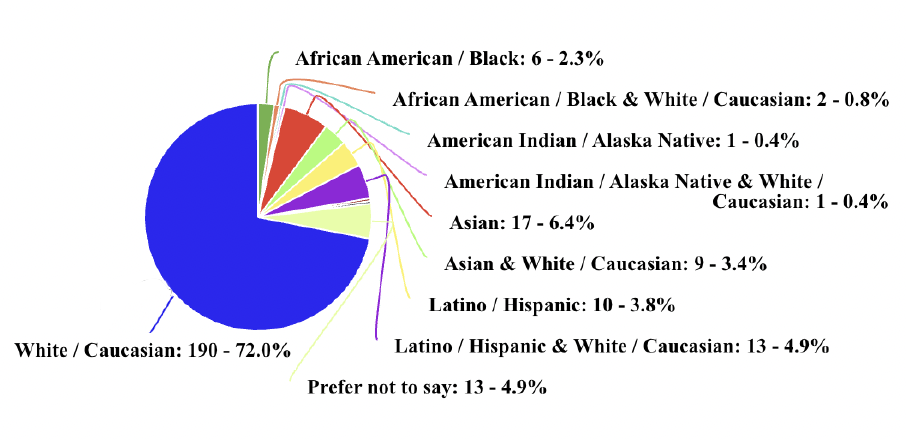
Figure 4. Abortion Opinions Distribution*

*Excluding missing data
A linear regression analysis examined whether demographic variables predicted trends in these scores. Sex had the strongest and most statistically robust effect in the model: controlling for other factors, males averaged about 1.08 points higher than females (p = .001). Non-White participants also had slightly elevated scores—on average 0.55 points greater—compared to their White peers (p < .050). Class level and non-response were not significant predictors (p = .498 and p = .113, respectively). Overall, this model captured only a very small portion of the variance in attitudes (R² = .066). The role of political orientations of students was not studied—a definite area for future improvement and further inquiry. Going forward, we also would be interested in adding other potentially significant predictors to the model, such as political ideology, denominational or theological affiliation, and area of study.
Nevertheless, the survey’s free-response portion offers a detailed look at the nuanced perspectives of students on the issue.
First, in the words of the College’s Community Covenant, students confess and “uphold the God-given worth of every man, woman, and child—from conception to natural death—as a unique and equal image-bearer of God” (Wheaton College, 2026). Interested in how students understand divine image-bearing in this context, we asked how the image of God might be affirmed in all persons involved in abortion.
By far the most dominant response emphasized the sanctity of unborn human life and the imperative of its protection. These answers framed human life as beginning at conception, characterized abortion as morally wrong (often as murder), and affirmed the unborn as full image-bearers of the Imago Dei. Others adopted a more relational tone, stating that affirming God’s image entails practices of love, attentive listening, and showing grace to everyone. Related to this, many student respondents also communicated that upholding dignity involves tangibly supporting women, giving examples such as financial and emotional support, adoption and foster care advocacy, church involvement, and post-natal care as examples. Other respondents widened the scope by maintaining that honoring the value of all persons requires addressing broader systems and social issues like poverty, healthcare, childcare, and education. Almost a dozen students cited the woman’s bodily autonomy, moral agency, and (in some cases) doubt of fetal personhood. These and other key themes are presented in Table 1.
Table 1. How we can affirm the Image of God in everyone (n = 172)*
| Category | Description | (n) | (%) |
|---|---|---|---|
| Pro-Life / Fetal Personhood | Fetuses bear Imago Dei from conception; abortion framed as morally wrong or killing | 48 | 27.9 |
| Compassionate Relational Ethic | Emphasizes empathy, listening, non-judgment, & loving tone toward mothers and families, regardless of stance | 27 | 15.7 |
| Practical Care & Resource Provision | Focus on tangible support: financial aid, healthcare, adoption/foster systems, church/community support, postnatal care | 31 | 18 |
| Structural Justice / Systems | Attributes abortion context to systemic issues like poverty, healthcare access, education, sexual violence, & inequality | 14 | 8.14 |
| Bodily Autonomy & Fetal Personhood Skepticism | Prioritizes pregnant mother's autonomy or questions fetal personhood | 10 | 5.81 |
| Integrated "Both Lives Matter" Ethic | Strong affirmation of fetal life & equally strong emphasis on supporting and protecting mothers; rejects either/or framing | 22 | 12.8 |
| Contextual Exceptions & Moral Ambiguity | Recognizes special cases (rape, incest, medical risk) or expresses uncertainty about universal rules | 9 | 5.23 |
| General Imago Dei | Affirms universal human dignity as Imago Dei without clearly applying it to abortion policy or moral stance | 11 | 6.4 |
*Non-analytical and non-responsive data were excluded.
We also studied the ethical reasoning that makes abortion a complex issue for survey participants. Very few respondents—34 in all—said they believe there are no circumstances under which abortion is permissible. However, 146 gave examples of what they said they believe are exceptions.The three exceptions most commonly cited were rape (including incest and coercion), grave risk to the mother’s life, and fetal non-viability or severe anomalies. These and other responses are presented in Table 2.
Table 2. Exceptions for Abortion (n = 180)*
| Exception | (n) | (%)** |
|---|---|---|
| Rape / Sexual Assault (incl. incest, coercion) | 128 | 24.7 |
| Mother’s life / Serious Health Risk | 112 | 21.6 |
| Fetal Non-Viability / Severe Anomalies | 18 | 3.47 |
| Incest (explicitly named separately) | 54 | 10.4 |
| Minor / Child Pregnancy | 28 | 5.41 |
| Ectopic Pregnancy | 20 | 3.86 |
| General Medical Complications (non-specific) | 41 | 7.92 |
| Severe Fetal Disability / Deformity (non-viability separate above) | 19 | 3.67 |
| Mental health / Psychological Harm | 9 | 1.74 |
| Extreme Poverty / Financial Instability | 24 | 4.63 |
| Lack of Support Systems / Foster Care Concerns | 21 | 4.05 |
| Abuse / Domestic Violence (non-rape) | 14 | 2.70 |
| Human Trafficking / Coercive Relationships (explicitly named separately) | 6 | 1.16 |
| Teen Pregnancy (non-rape specific) | 11 | 2.12 |
| Unwanted Pregnancy (general) | 13 | 2.51 |
*Non-analytical and non-responsive data were excluded; A single response can include multiple exceptions; Counts reflect mentions, not unique respondents per category.
**Percent of all exceptions provided.
As for the effect of Dobbs v. Jackson on the issue, students varied in their responses. The majority of survey participants said the ruling increased the issue’s complexity, pointing to state-by-state legal uncertainty; heightened polarization that threatens public discourse; ethical tension (especially between faith and policy); and the lived, immediate consequences for women and providers navigating unpredictable terrain. Meanwhile, a significant portion of respondents said the issue became simpler for them because the ruling brought abortion policy into closer alignment with their personal moral and religious beliefs. In the eyes of many in this camp, abortion in the U.S. became clearer because to them it is morally straightforward. Another considerable number of participants reported no change at all in their views, mostly for the same reasons. Specifically, to these students, abortion is a moral gash that cannot be treated with a legal Band-Aid. The response pool also included mixed answers falling into more than one category. The findings related to this question are presented in Table 3.
Table 3. The Effect of Dobbs v. Jackson on Perspectives (n = 180)*
| Category | Number of Responses |
|---|---|
| More complicated | 64 |
| Less complicated | 38 |
| No change / Neither | 52 |
| Mixed / Depends | 12 |
| Uninformed / No opinion / Not enough knowledge | 14 |
*Non-analytical and non-responsive data were excluded.
Over fifty years after Roe v. Wade and a few since its overturning, abortion remains a touchy topic in the American political world. Debates on the ethics and politics of abortion at times turn ugly because of its fundamental implications and deeply felt difficulties. What is at stake feels critical, self-evident, and in some cases even non-negotiable—for the mother, the right to control her body; for the child, the right to life. Properly discerning the issue therefore involves wrestling with its ethical complexities, applying a gracious and philosophically robust framework of personhood, and never forsaking the interests of any parties at play. And because of abortion’s deep political character, with shifts in the past few years lending the problem another layer of legal intricacy, we must also take care to not lapse into quarreling, but to engage with clarity, seriousness, and respect for life. May we pursue truth and justice, but never at the expense of grace.
Asa Thurstone
CACE Student Fellow
References
Duignan, B. (2026, March). Dobbs v. Jackson Women’s Health Organization. Encyclopaedia Britannica.
Wheaton College. (2026, February). Community Covenant. Wheaton College.