Words: Juliana Bacote ’24
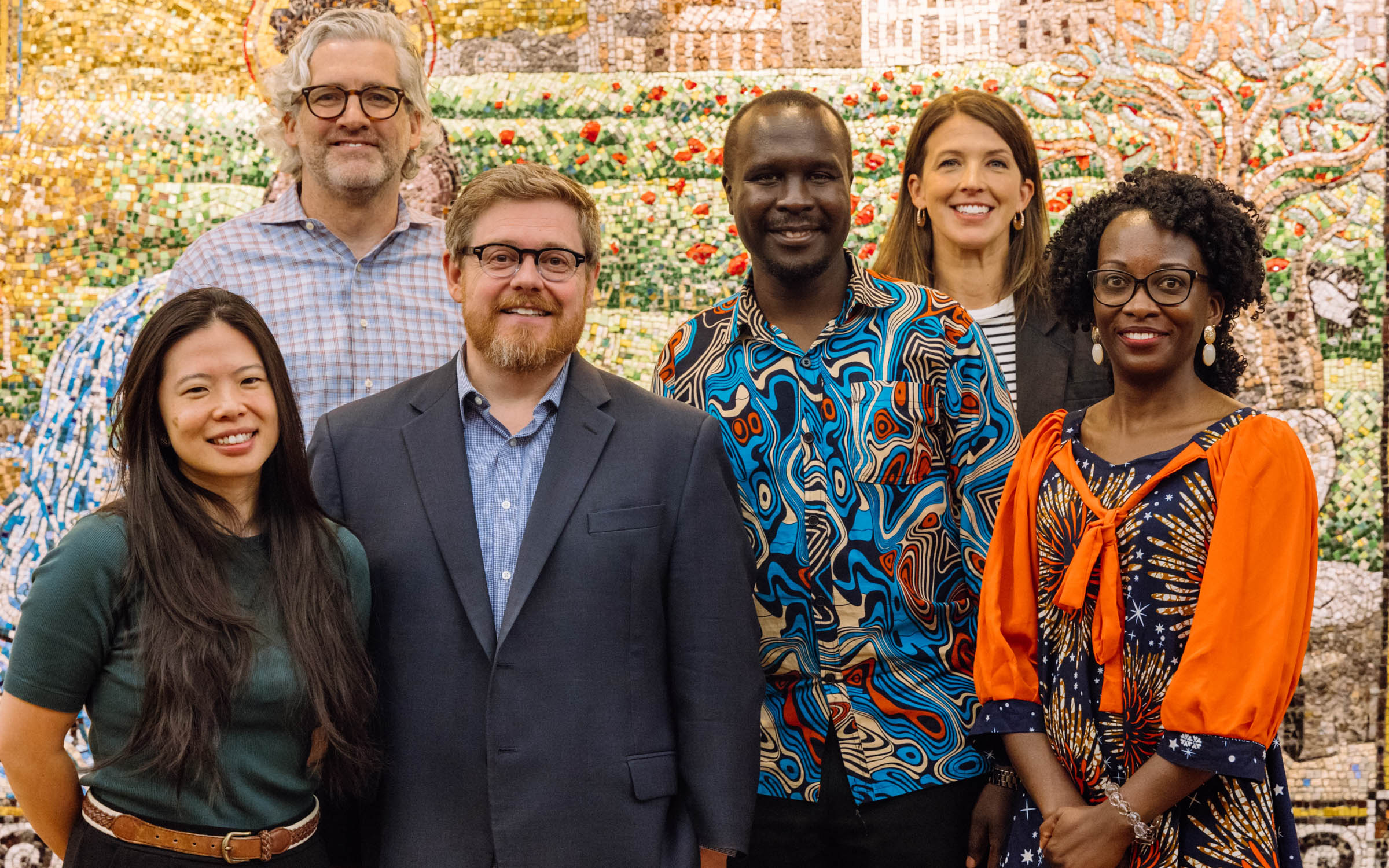
Row 1 (L to R): Joy Lee, Dr. Jamie Aten, Dennis Kilama M.A. ’21, Yvonne Kilama. Row 2 (L to R): Kent Annan, Dr. Jamie Goodwin.
Photo by Kayla Smith
Wheaton College’s Humanitarian Disaster Institute (HDI) has been equipping students to serve their neighbors around the world since 2011. Jonathan Dahlager ’21, a member of HDI’s first Master’s in Humanitarian & Disaster Leadership cohort in 2019, has used the tools he learned at HDI every day in his development work at World Vision.
“HDI equipped me to navigate this whole world of humanitarian development,” Dahlager said. “I think the most valuable aspect of the program was learning about the main things this sector revolves around, the structures, the main actors, logical frameworks in creating an organization, how it operates, response guidelines, how to help without hurting, and communicating with donors. I didn’t know what boxes to fit things in before. Thanks to HDI, I now do.”
Dahlager served as a fellow through the WASH (Water, Sanitation, and Hygiene) program in the United States for two years following graduation from his master’s program. A few years and a job transition later, World Vision asked Dahlager if he would step into the role of Senior WASH Manager at World Vision Senegal to revamp a program that had been struggling.
The role has entailed lots of learning about culture and leadership and building trust with his teammates. “I learned about the culture in the Senegal office and in the country more broadly, learned how they work, looked into what hasn’t been working, and sought to identify what were cultural and local differences versus what was genuinely broken,” Dahlager said.
He says he wouldn’t have been able to do any of this without having his HDI foundation. In addition to providing Dahlager with the framework needed to work in the humanitarian sector, HDI enabled him to pull from networks and resources that were largely initially given to him by the program. “I think HDI is a fantastic institute,” Dahlager said. “Having worked in this field, I think the work they do is exactly how it needs to be done.”
This past July, Wheaton College’s Humanitarian Disaster Institute celebrated its 15th anniversary. The institute, which is the first faith-based academic disaster research center in the United States, houses undergraduate and graduate programs that examine complex global challenges through a Christian academic lens. As described on HDI’s website, “Grounded in rigorous research and informed by practice, HDI prepares students to translate scholarship into meaningful service and leadership across faith-based, nonprofit, humanitarian, and disaster contexts worldwide.”
The graduate-level programs include the new Master’s in Nonprofit Leadership (which launched in fall 2026), the Master’s in Humanitarian & Disaster Leadership, the Humanitarian Leadership Certificate, and the Trauma Certificate. Undergraduate options include the Humanitarian Action Certificate and the Accelerated Master’s in Nonprofit Leadership or Humanitarian & Disaster Leadership.
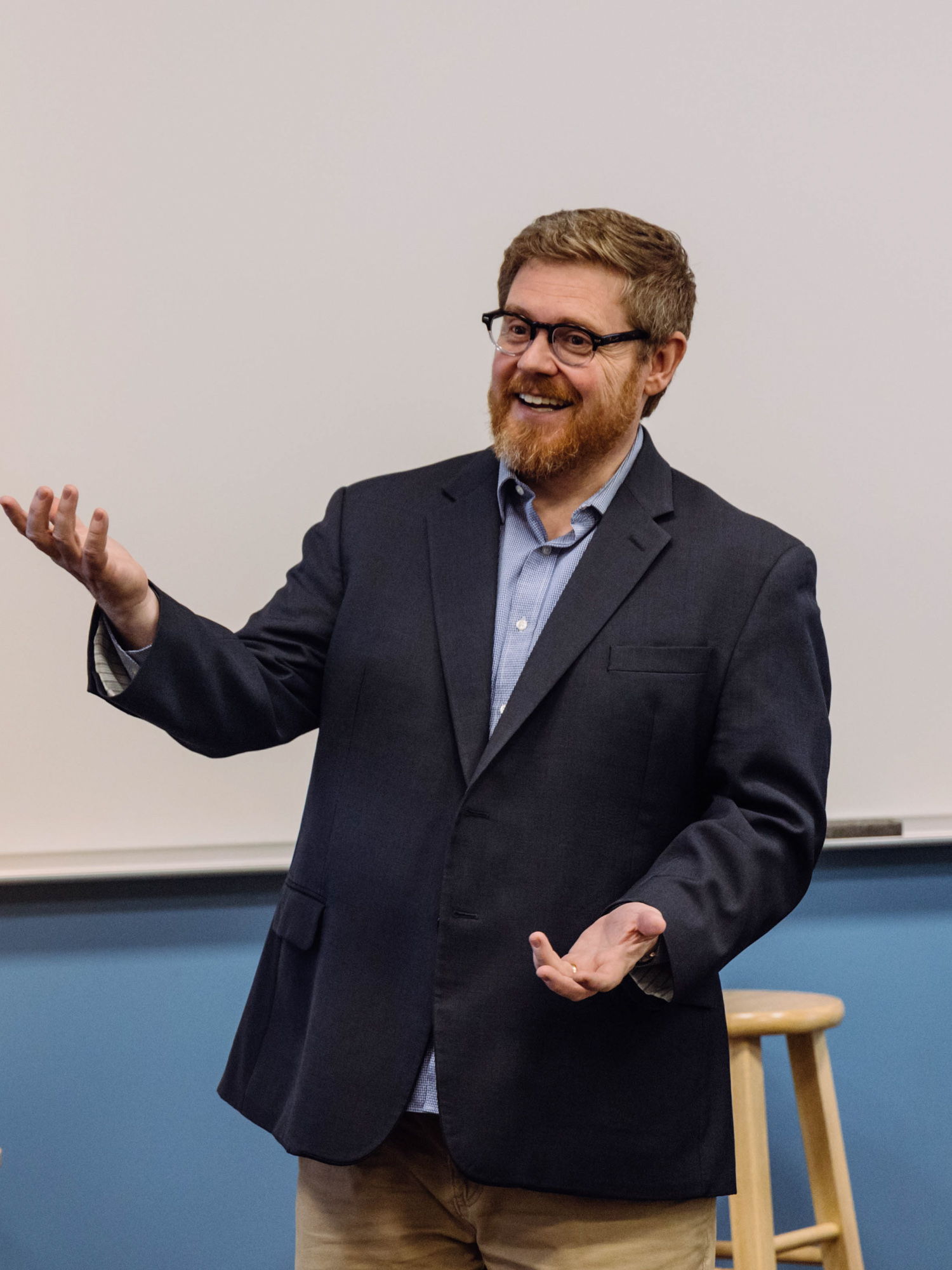
Dr. Jamie Aten teaches.
Photo by Kayla Smith
“Fifteen years ago we started with a simple question: how can the church help in times of crisis?” founder Dr. Jamie Aten said. “Our team has spent every year since turning that question into research, training, and real care for people who are hurting.”
Dr. Jamie Aten, Blanchard Chair of Humanitarian Disaster Leadership, Executive Director of Humanitarian Disaster Institute, and Professor of Humanitarian Disaster Leadership, first conceived the institute after experiencing Hurricane Katrina in 2005. “I was in my first teaching job at the time and pulled together a team of students to start doing some research and trying to figure out how we could help,” Aten said. “And I can still remember being in Mississippi and looking at this church along the coast that was completely gutted out on one side, cars piled up, boats even up on land in the parking lot. And I realized there wasn’t a place that the local church could turn to for resources that were both biblically informed and scientifically informed.”
So, he decided to create one. “That’s where the vision for what turned into HDI came from, just standing there and seeing that large need,” said Aten. “And then, five years later, I came to Wheaton and started the process of getting the institute up and running.”
Aten came to Wheaton in July of 2010 after receiving an invitation to serve as the endowed chair in the clinical psychology department. When he began in this role, Aten already had a second goal for his time at Wheaton in mind. “When I came, I came with a write-up in hand for the idea of an institute,” Aten recalled. “One of the things I had seen from doing disaster work for several years was that groups and even researchers would come in and actually cause harm when trying to help. But then I got connected to a number of other collaborators from some major research institutes and was able to see how the right kind of foundation could make doing this work possible. But, some sort of infrastructure was needed to be able to do this work well.”
The following July, the institute opened as a research institute in Wheaton’s PsyD in Clinical Psychology program. Then Aten observed a new need.
Aten held a one-day focus group at the annual Accord Network conference, where church and ministry leaders gather to make progress in the relief and development sectors. His plan was to develop a one or two-day disaster training for these leaders. But the participants expressed their desire for master’s level education. “Some graduated from a top university, but they’re not sure how to engage their faith in their professional role,” Aten said. “And we have people whose faith is very strong, but they lack a technical capability. They need something to fill that gap. So, it was actually in that focus group that we carved out the beginning of what would become the Master’s in Humanitarian Disaster Leadership program.”
One of the key players who shaped the master’s program arrived at Wheaton in 2017. Kent Annan, who serves as Director of and Senior Lecturer in Humanitarian and Disaster Leadership, was brought on to direct the master’s program and later to also co-direct the institute alongside Aten.
Both Aten and Annan teach various classes in the institute, some of which they co-teach. Dr. Jamie Goodwin also teaches courses. Other members of the HDI team include Joy Lee (HDL Program Administrator/HDI Associate Fellow), Kiki Cherry (Outreach and Project Manager), and Rose Mumma-Dickson (Office Coordinator). Aten focuses largely on disaster mental health and trauma, while Annan specializes in areas like non-governmental organization (NGO) leadership.
When Bri Allison ’26 M.A. ’27 took NGO Leadership with Annan as an undergraduate, she said the class “blew her mind.” “It was kind of that light bulb moment of, whoa, I understand this, and I can do this,” Allison said. “And he was just very encouraging towards my passion. Taking that class with him was a really great way to start my journey in this program.”

Bri Allison ’26 M.A. ’27 sits in class with fellow students.
Photo by Donovan Michel ’25
Allison, who graduated from Wheaton with a bachelor’s degree in Christian Formation and Ministry and a Humanitarian Action Certificate, is part of the Accelerated Master’s in Humanitarian & Disaster Leadership program. During her sophomore year, she learned about the accelerated program and began taking classes through it as a junior. Fueled by a strong sense of justice and a desire to alleviate suffering in the world, Allison is passionate about challenging the inequality many women face. “Whether it’s working to end violence against women and girls, human trafficking, or another issue, I’m hoping to get a job in that sphere,” said Allison.
The summer following her undergraduate graduation, Allison had the opportunity to intern with Samaritan’s Purse in Asia and gain real-life experience in that same sphere. In Cambodia, she served as the Protection Projects Intern, which supports the team that addresses safety related to three vulnerabilities: unsafe migration, gender-based violence, and online child sexual exploitation.
But prior to her internship, Allison already felt as though she was getting real-life experience in her HDI classes. “You’re treated kind of as if you are already practitioners,” Allison reflected. “It can involve a lot of mapping things out and Excel sheets. It’s very strategy-based.”
Along with that, students are held to a similar level of responsibility as professionals in the field. “There are high standards for people in this space because you have a lot of responsibility to make sure you’re not hurting people and are actually helping them,” Allison shared. “We’re treating people as whole persons who have more than just spiritual issues or just physical issues, and addressing all the different spheres of what it means to be a human. We’re helping people in a way that matters now and also for eternity.”
This humble attitude is what Aten hopes all HDI students will maintain when approaching their work. “It’s a hurting world out there, and it needs humble helpers, not heroes,” he said.
Annan, too, desires this for their students, and also wants them to grow into research-informed, effective leaders who are rooted in their faith. “Being a leader includes being a good follower and having vision,” Annan said. “With that, students also need sector expertise and the ability to innovate to serve people in the best ways possible as things keep rapidly changing.”
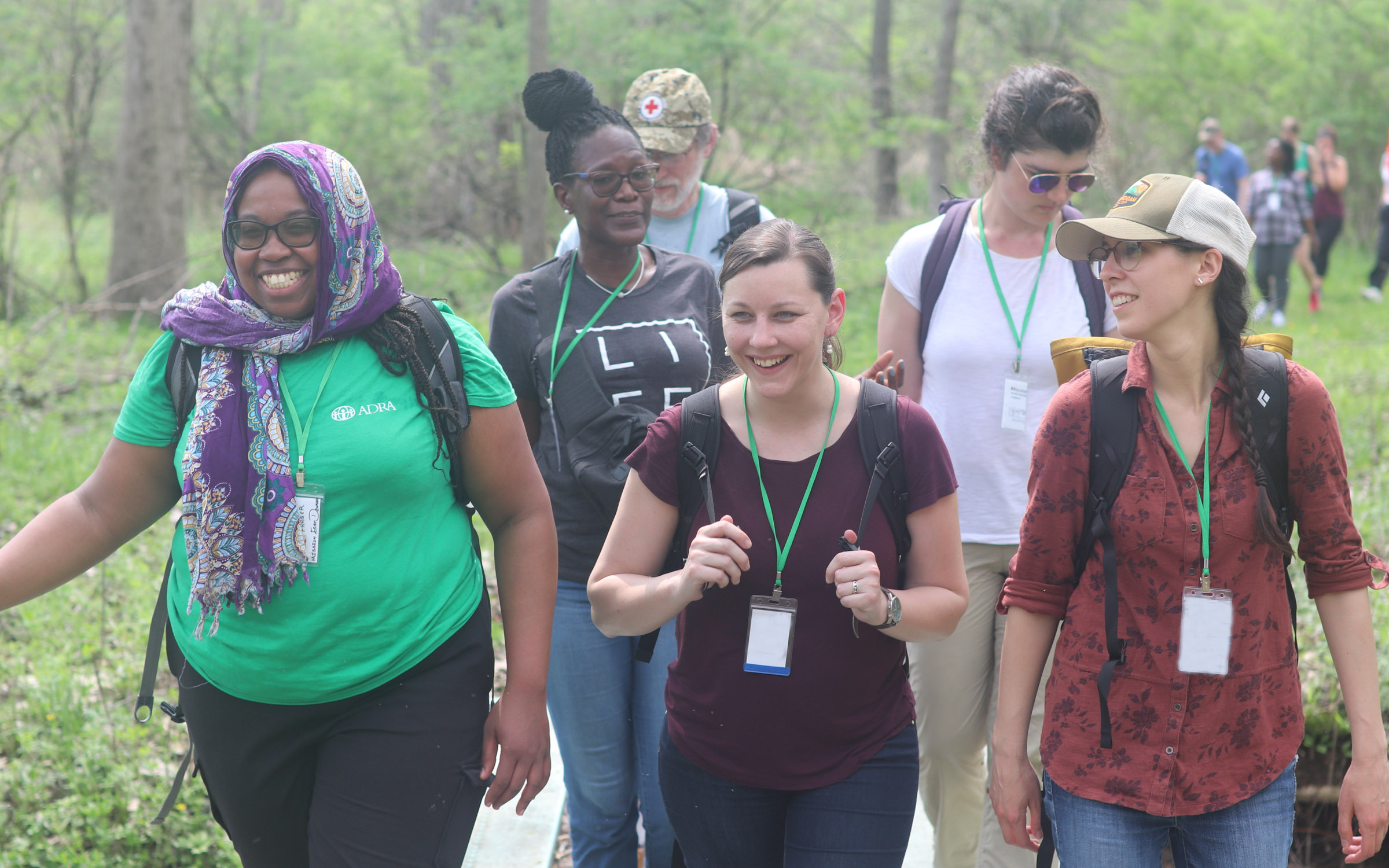
Students in an intensive embark on a field operation.
Photo courtesy of Joy Lee
Outside of the classroom, Aten and Annan continue to be students themselves as they conduct research to identify the best ways to provide spiritual and emotional care to those facing a crisis or disaster. “It’s been really exciting to see that we’ve been able to do around 12 million dollars’ worth of research during these 15 years,” Aten said. “That research has been possible in part due to receiving over 12 million dollars in competitive research grants and has led to over 100 scholarly publications.”
One such research project began when Aten and Annan traveled to Ukraine about six months after Russia invaded the country in 2022. The pair led a Spiritual First Aid training in Ukraine for nearly 200 people, including nonprofit leaders, church leaders, and missionaries, which has led to an ongoing research project that creates Ukrainian resources they hope will be used across the country.
Developed by Aten and Annan, Spiritual First Aid is a training designed to help churches, Christian helpers, organizations, and networks care for mental health through a step-by-step spiritual and emotional care framework with tools rooted in biblical teachings. More recently, they launched the online Spiritual First Aid Academy to provide more people with access to the training.
Since HDI’s inception, the institute has deployed in about 35 different countries, including Japan and Kenya. Following the 2011 Tōhoku earthquake and tsunami in Japan, HDI collaborated with World Relief, Covenant World Relief, and Japan Evangelical Association to organize virtual emotional care trainings and capacity building in Japan over a three-year period. And over a ten-year period, HDI worked with the International Association for Refugees (IAFR) to equip pastors in the Kakuma refugee camp in Kenya with trauma care training and theological training.
Looking back over the last 15 years, Aten reflects on the institute’s humble beginnings.
“It’s really taken on a life of its own beyond what I could have even imagined,” he said. “What I initially proposed was something that was just going to be focused largely on domestic emergency management type of disaster work, but I’ve seen it grow into this interdisciplinary institute for academic programs that works globally. I’m really incredibly blessed by the way that God has opened opportunities for us to serve others.”
God has also opened doors for the institute’s work to be recognized by outlets such as the New York Times, BBC, and Washington Post, and awarded by FEMA (the Federal Emergency Management Agency), the American Psychological Association, and the Evangelical Press Association. Aten was also invited to consult at the White House under three different administrations.
Amidst the rewarding but emotionally taxing work the institute engages in, the faculty and students repeatedly redirect their eyes to the God they serve. “God laments disasters and horrible things along with us,” Dahlager said.
The programs teach that caring for people in disaster situations includes both quick responses and the long work of rebuilding. “God’s not going to rush restoration.” Allison said. “So, when we don’t see world hunger being solved immediately or everyone being freed from trafficking, it’s not that nothing is happening. It’s just that God’s kingdom is slowly coming to fruition. And we’re called to continue to take steps and walk faithfully towards that end.”
Alumni sometimes return to campus and share how they are doing just that. At the kickoff course for the Humanitarian Disaster Leadership master’s program, Aten and Annan invited some alumni to sit on a panel to share about their current endeavors. One alum recently received nonprofit status to be able to do work in Haiti for an NGO they are starting, while another works for an Illinois-based NGO that operates in Malaysia and other countries around the world. A third alum on the panel also lives in the Chicago area and works with refugees.
“It’s always so encouraging to have our alumni come back and to hear the things that they’re doing and the relationships they’re building,” Aten said. “Our team regularly talks about our institute as a community, and I’m just so grateful for our team, alumni, students, partners, and the whole HDI community I get to do work with.”
