
Week Three
Read Matthew 2:3–9
Trusting the Signs
“Assembling all the chief priests and scribes of the people, [Herod] inquired of them where the Christ was to be born. They told him, ‘In Bethlehem of Judea.’”
Adoration, alas, is not the only possible response to revelation.
The Magi see the signs and set out to worship; Herod hears the news and begins to scheme. And yet, this is an especially comforting passage of Scripture. Herod resists the birth of the Christ child, but his attempts to manipulate the Magi fail. Had he paid attention to Scripture, Herod would have known where the Christ-child was to be born: Matthew amusingly points out that the location was there in the Bible all along! But Herod missed the obvious, so pagan Magi from beyond Israel were sent to confirm what Scripture so evidently teaches.
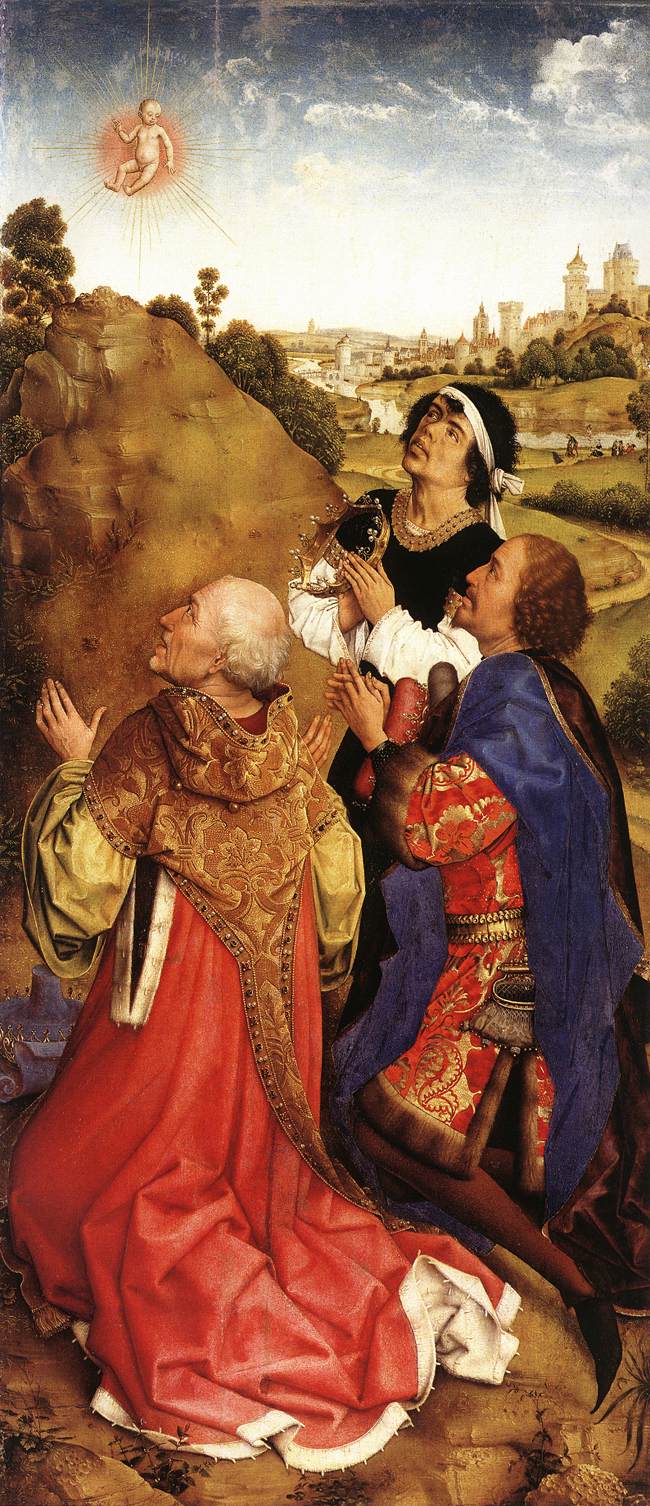 I love how the fifteenth century artist Rogier van der Weyden depicts those Magi, following Jesus who hovers above them like some kind of divine basketball. One thinks here of the words of Thérèse of Lisieux, “Your ineffable image is the star that guides my steps.” Again, there is much to comfort us here. The political darkness of Herod’s reign did not thwart God’s plans. The Machiavellian plots to thwart the birth of the Christ child were themselves thwarted.
On the other hand, this passage is especially disturbing. Without discounting the literal meaning—that God became flesh and is the Lord of all nations—the passage has another meaning. In fact, there is a great evangelical tradition, extending back to the medieval mystics of Germany (Henry Suso and John Tauler), through Martin Luther and into German pietism (Johann Arndt), that teaches that this passage is also about us. Not only are our hearts a Bethlehem where Christ is born in faith, but there is a Herod within us as well. What parts of me are trying to manipulate Christ to my own selfish ends? It is an unsettling thought, one that leads me to a somewhat terrifying prayer: May my own inner Herod be thwarted as well!