 BHS Gets a New Autoclave!
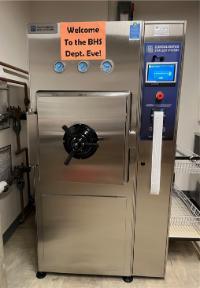
After 15 years of service, "Bertha" the former Biological and Health Sciences autoclave is replaced by "Eve" our new Consolidated autoclave! The Biological and Health Sciences welcomes "Eve"!
BHS Majors Attend the 57th Annual ACCA Student Scholarship Symposium
On Saturday, April 5th five Wheaton College students attended the 57th Annual ACCA Student Scholarship Symposium hosted at Lewis University. The annual symposium is sponsored by the Associated Colleges of the Chicago Area (ACCA), a consortium of 14 private liberal arts colleges from around the Chicago-land area. The symposium features undergraduate research in STEM and Social Sciences.
Students from Dr. Meredith Sommars’ lab attended, including Mattias Dyrud and Anastasia Lau. Mattias 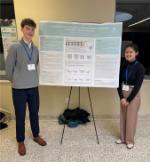 presented his work entitled, “Effects of coconut oil on hepatic lipid accumulation, cell viability, proliferation, and gene expression.” His research sought to disentangle the health impacts to human liver of consuming coconut oil. This trendy health food has generated conflicting evidence regarding whether its consumption improves or exacerbates lipid accumulation in the liver. Mattias made a surprising discovery that suggests coconut oil may in fact promote mitochondrial biogenesis in human liver cells, a result which may lead to future studies.
Dr. Derek Rosenberger's lab was also represented, with three students - Hannah Chung, Charlie Leys and 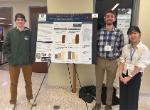 James Petno - presenting research titled "Tribolium flour beetles: Stored product pests and secret saprophages?". Three other students who contributed to the work - Sam Elsen, Lela Plankeel and Isabelle Pastoor - were unable to attend. The team's work investigated the historical habitat associations of two Tribolium flour beetles, which are important invasive species that cause severe economic damage to stored grains worldwide. These beetles also serve as a model organism for ecological and behavioral studies. The team found that Tribolium beetles have a surprisingly high attraction to rotten wood, well beyond that of the wheat flour upon which they are a pest. These findings may explain how these beetles are able to persist on the landscape despite efforts to control them at grain mills.
Research engagement is an important part of student training in the Biological and Health Sciences department at Wheaton College. Every year dozens of students are mentored by faculty in their research labs, making discoveries about how life works and growing in their understanding and appreciation of God's good creation.
"Transformative" Microscope
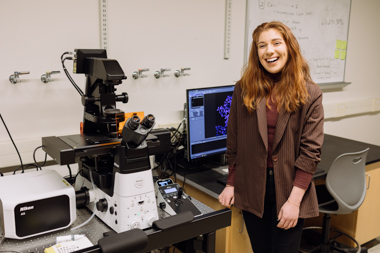
On January 21, 2025 Wheaton College unveiled a confocal microscope that was gifted to the College. Confocal microscopes are typically found at large research universities due to their substantial cost. This positions Wheaton College among a select group of primarily undergraduate institutions with such advanced research equipment.
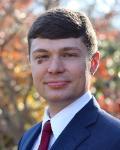 “Having access to a confocal microscope at a small Christian college like Wheaton is quite uncommon and a real blessing,” said Dr. Corbin Renken, Assistant Professor of Biological Health and Sciences.
Two BHS Majors Receive Significant Award
Kenna Oyen and Grace Snavely, BHS Majors receive the Great Physician Scholarship, a one-time award towards spring tuition for a junior pre-medical student (by class year, not credits) with a GPA of 3.5 or higher. Congratulations Kenna and Grace!
Dr. Dana Townsend Retires After 13 Years of Service
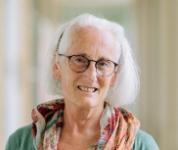 Dr. Dana Townsend, Associate Professor of Biological and Health Sciences, retired June 30, 2025 after 13 years of service at Wheaton College!
Dr. Townsend received her B.S. and M.S. in Biology and her Ph.D. in Physiology from Kansas State University where she received numerous honors and awards as an instructor in the Division of Biology for her proficient teaching in anatomy and dissection of cadavers. Dr. Townsend came to Wheaton College after teaching anatomy at the Kansas University School of Medicine. She applied this accumulative knowledge in the Applied Health Sciences department which merged recently with Biology, now named the Biological and Health Sciences department.
Dr. Dana Townsend regularly taught Anatomy to 65-80 students during the fall semesters, administrated teaching assistants and peer tutors for her labs, taught upper-level anatomy and dissection courses, Wellness courses, and CORE course Neurobiology and Spiritual Formation.
Dr. Townsend’s scholarship included co-authoring a lab manual for use at Wheaton College, presentations with students at national meetings, research publications in journals such as Experimental Physiology, Respiratory Physiology and Neurobiology, Journal of Applied Physiology, and Diabetes and Metabolic Syndrome.
Dr. Townsend’s institutional service included being Chair of the AHS department, Student Conduct Panel, Institutional Review Board, Intercollegiate Athletics Committee Faculty Representative, Faculty member of the Student Life Subcommittee, Passage Faculty, Breakaway Leader, HNGR mentor, taught at Wheaton in the Northwoods, Art Exhibition Guideline Committee, and Faculty advisor for the Thunderbirds.
In her free time, Dr. Townsend would often entertain and cook for students and church members in her home, had time to mentor students, and financially support Wheaton students and missionaries.
Over the years that Dr. Townsend taught at Wheaton College, her students not only remember her and sing her praises as a wonderful teacher with vast knowledge in human anatomy and dissection skills with cadavers, but also her Christ-centered consciousness, kindness, and generosity.
Dr. Dana Townsend will be greatly missed by her students and the BHS department.
Dr. Nadine Rorem Retires after 31 Years of Service
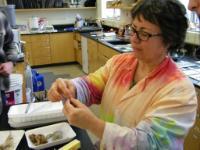 Dr. Nadine Rorem, Professor of Biology in the Biological and Health Sciences retired 6/30/24 after 31 years at Wheaton College and will be greatly missed by her students and the BHS department! Her versatility of teaching courses from freshmen to upper level, CATC courses, HoneyRock, Black Hills, and Marine Biology in the Caribbean along with co-advising and developing the campus garden teaching students gardening and compost skills will be hard to replace!
Dr. Rorem has also been a staunch researcher acquiring several grants, publishing in journals such as Invertebrate Biology, Molecular Ecology, Biological Invasions among others. She and her research students manage aquaria containing her research specimens of invasive colonial hydroid, Cordylophora and recently freshwater jellyfish that they utilize for research. She also served Wheaton College as the Vice-Chair of the Faculty, and on several committees throughout her career such as the Faculty Personal Committee, Honduras Project Advisory Committee, HNGR Advisory Committee, Intercollegiate Athletics Subcommittee, Sabbatical Committee, etc.!
In Fond Memory of the Rev. Dr. Albert J. Smith
Thoughts by Dr. Rodney Scott
 The Rev. Dr. Albert J. Smith was a wonderful teacher, an insightful biologist, and a servant of God who lived out the Wheaton College motto “for Christ and his Kingdom”. On February 10th, 2021, at the age of 88, Dr. Smith passed away, but the marks he left on the Biology Department of Wheaton College will endure.
Dr. Smith was an alumnus of Wheaton College, who came to the institution as a student with the intention of training to enter the mission field. Though he later attended Northern Baptist Theological Seminary and pastored church for several years, he fell in love with the study of Biology while attending Wheaton. It was also during this time, that he fell in love with his sweetheart Audrey, who would later become his dear wife. After graduating from Wheaton, Al obtained a master’s degree in Ecology from Northern Illinois University and went on to teach Biology at nearby Judson College from 1964-1967. In 1967, he returned to Wheaton College, where he taught Biology for 32 years. In the early days of his teaching career at Wheaton, he received a grant from the National Science Foundation that helped him to earn a PhD from the University of Chicago.
During his 32 years at Wheaton, Al Smith Helped to expand the beloved Black Hills program, and even helped to build some of the buildings on the Black Hills campus. He taught all kinds of classes from Botany, to Bioethics, and from introductory Biology to the Senior Capstone course. But I remember him most for the course that became his specialty, Genetics. Al wasn’t trained as a geneticist, but I’m sure none of his students realized that, as he taught them the details of the field with enthusiasm and insight. However, as the field of Genetics became more and more technical with new discoveries in the late 1980s, Al recommended that the Department hire someone with specific training in genetics to teach the course. And that’s how I got my job at Wheaton.
Coming straight to Wheaton from my graduate work and having earned my PhD studying the genetics of a fairly obscure plant, I was excited about my new position, but more than a little nervous about taking on the role of the Wheaton College geneticist. I was also more than a little nervous about being the young upstart who would take over Al’s beloved genetics course. But I didn’t need to worry, Al was one of my most gracious supporters. He even co-taught the course with me in the early days, helping me to “learn the ropes”.  Looking back, I see that teaching others how to teach was just part of who Al was. I know that many of my colleagues experienced similar encouragement and mentoring from Al, and scores of students over the years gained similar inspiration from him. For many years, Al taught the “Science for Teachers” course and observed student teachers from our department when they had teaching internships in the community. He also modeled a practice that continues in our department to the present time of giving our Teaching Assistants the opportunity to present pre-lab mini lectures from time to time. Given that some of these students have gone on to careers in academia, Al’s legacy as a teacher of teachers continues to have a far-reaching impact.
Al not only helped me and others to become better teachers, he also taught us by example quite a bit about what it means to integrate science and faith into our teaching. As part of his passion for the study of bioethics, he introduced me to the details of the American Eugenics movement, a time in the history of our nation when genetics was used to justify evil actions that opposed the truth that all humans are made in the image of God. He also modeled ways of carefully working with both Biology Majors and non-majors to sort out questions about evolution. He was one of the founding faculty members who established the popular, multi-disciplinary course “Theories of Origins” in the mid-1990s. He also modeled what it meant to be a “pastor-teacher”, mentoring students outside of the classroom, and frequently praying for and with them in all kinds of settings.  He was often our go-to person in the Biology Department for sharing an inspiring sermonette during a departmental chapel, and his willingness to do such things eventually helped others of us to take up that challenge as well. Finally, all of us who worked with him remember hearing his strong sweet voice leading his students at the start of a class session in singing his favorite hymn “This is my Father’s World”. This hymn so warmly remembered by those of us who were his colleagues and by countless students from years past, speaks volumes about who Al was. He dearly loved both the natural world that God made and its creator, and he did everything he could to encourage the same feelings in those around him.